Climate Change
As communities across the United States are faced with the health and societal effects of climate change, local health departments are uniquely positioned to identify, prevent, and respond to climate-related health impacts in an equitable manner. NACCHO aims to provide resources to ensure local health departments are equipped to take on this role, while elevating best practices and success stories at the local level.
View success stories of climate change adaptations occurring in a local health department near you!
Success stories:
- Highlight local efforts to prepare for and build resiliency to the health impacts of climate change;
- Support new and ongoing initiatives in other local health departments;
- Identify best practices;
- Provide real-world case studies; and
- Highlight only a few of the many departments actively engaged in climate change efforts.
NACCHO invites our members to submit stories that highlight and showcase local climate change work. Click on a state below to see local climate adaptation initiatives undertaken by our Climate and Health grantees and partners.
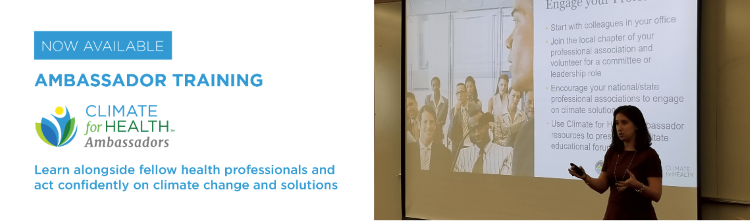
Prepare to take the training by signing up HERE.
Additional resources addressing the health impacts of climate change and what local health departments are doing and can do are listed below.
The NACCHO Global Climate Change Workgroup is committed to providing leadership and resources to support local health department climate change efforts. The workgroup is comprised of local health officials, environmental health professionals, environmental health directors, and subject matter experts who are interested in enhancing climate change adaptation and mitigation policies and practices.
The workgroup holds at least one in-person meeting (pending funding), monthly conference calls, and work in between meetings. In addition, the workgroup reviews documents and participates in judging model practice applications throughout the year. Appointment to the workgroup is for a two-year term with an option for reappointment to a second two-year term. Message [email protected] for more information.
Below are some of the most recent webinars hosted by NACCHO related to climate change. For additional resources, check out NACCHO's Toolbox where you can filter out tools in the Climate Change Toolkit.
Get to Know Your NACCHO Climate Ambassador Community (October 2023)
Climate for Health Ambassadors from local health departments across the country met to discuss their work and learn about new tools and resources for climate action.
- Catch up with the recording.
- Download the slide deck shared by presenters.
- Explore resources shared during the meeting.
NACCHO & CDC Food Safety Sharing Session Recap: Climate Change & Food Safety (April 2022)
The webinar provided examples of the science behind climate change, its impact on the environment and our health, and what this means for food safety and food security. The sharing session also explained some of the recent expansion of climate change work at the federal level and helped provide context on how current food safety issues experienced at the local level are linked to climate change.
- Listen to the webinar recording.
- View or download the webinar slides from:
Western Wildfires – Keeping Communities from Polluted Air (May 2018)
See the role that local health departments play in preparing for and responding to wildfires and the health impacts of wildfire smoke.
NACCHO's Climate Change Community of Practice provides a space for individuals who are interested in, or work with, climate change resilience and mitigation. This virtual community can be used to share information, best practices, and resources relevant to climate change, and allow for participants to virtually network with others who work in this area of public health. To join, go to https://virtualcommunities.naccho.org/communities/allcommunities and search for "Climate Change."
Environmental Health Program
Chelsea Gridley-Smith
Director of Environmental Health
JavaScript is required to reveal this message. / Email
Environmental Health Program
Angana Roy
Sr. Program Analyst - Environmental Health
JavaScript is required to reveal this message. / Email
Environmental Health Program
Aliyah Al-Sadi
Program Analyst, Environmental Health
JavaScript is required to reveal this message. / Email